Mythical era
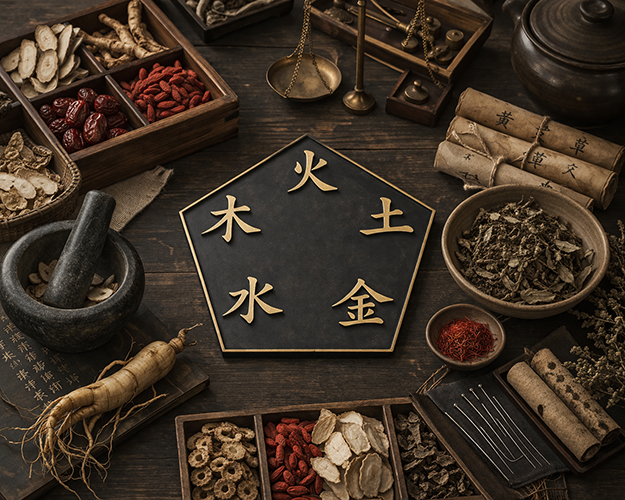
The mythical era of China: cultural heroes, primeval emperors and the roots of TCM
At the beginning of Chinese civilization lies a period that escapes historical verification yet is all the richer in meaning: the mythical era. It is the phase in which gods, heroes and legendary emperors laid the foundations for Chinese culture, philosophy and medicine. Although these figures cannot be historically proven in the modern sense, they are indispensable for understanding Traditional Chinese Medicine — for it is in this mythical era that its origin is situated.
The "historicizing" of myth
From the second century BCE onward, ancient legends, myths and orally transmitted stories were systematically brought together and written down. In doing so, they underwent a remarkable transformation: they were "historicized." Gods and clan leaders were turned into rulers with ministers, officials and advisers — an administrative structure that suited the bureaucratic system of the Han period, but was then projected back into a distant past. What had originally been mythical thus took the form of history.
This process is characteristic of many early civilizations, but in China it reached a special refinement. The mythical cultural heroes were arranged into dynasties, assigned regnal years and furnished with detailed biographies. The result is a pantheon of legendary figures that continues to define Chinese tradition to this day.
The Three Perfect Kings and the Five Primeval Emperors
In ancient writings, two rulers are mentioned at the beginning of history: Yao and Shun. Together with Yu — the mythical founder of the Xia dynasty — they are known as the "Three Perfect Kings": ideal rulers who led their people with wisdom and virtue. Later, the list was expanded to five primeval emperors, beginning with the Yellow Emperor Huang Di, followed by Shao Hao, Zhuan Xu, Diku, Yao and Shun — each linked to a season, a color, a direction and an element of the Five Elements theory.
Huang Di: the Yellow Emperor and founder of TCM
Of all mythical figures from Chinese prehistory, Huang Di is the most decisive for Traditional Chinese Medicine. The Yellow Emperor — whose name refers to the yellow earth of his birthplace, with Huang meaning "yellow" and Di meaning "emperor" — is regarded as the founder of Chinese culture in the broadest sense: from the invention of writing and the calendar to the foundations of medicine.
Huang Di is said to have lived from 2697 to 2596 BCE and to have reached an age of about one hundred years. His most enduring contribution to humanity is the Huang Di Nei Jing — the Yellow Emperor's Inner Canon — which to this day is considered the most authoritative foundational work of Traditional Chinese Medicine. The Nei Jing arose from the conversations Huang Di held with his physicians Qi Bo, Gui Yu Qu and Lei Gong. By recording those dialogues, he laid down the theoretical foundation of TCM.
The Huang Di Nei Jing: from shaman to physician
The Huang Di Nei Jing consists of two parts. The first part, the Su Wen (Questions on the Fundamental), deals with the theoretical foundations of medicine: Yin-Yang, the Five Elements, organ functions, pathology and treatment principles. The second part, the Ling Shu (The Spiritual Pivot), focuses on the practice of acupuncture: the meridians, the points and the needling techniques.
The Su Wen represents a historical turning point: the transition from a shamanistic, ritual form of healing to a rational medicine based on observation. It was the first great attempt to understand the human body, illness and healing through natural principles rather than supernatural intervention. Over the centuries, the Su Wen was rewritten and supplemented several times. The version known today is that of the Tang scholar Wang Bing, who edited and annotated the work in 762 CE.
Conclusion: myth as foundation
The mythical era of China is no side issue for the TCM student — it is the foundation. The figures of Huang Di, Yao, Shun and the other primeval emperors are more than legendary names: they represent the cultural values, philosophical principles and medical insights that define TCM to this day. Whoever understands the mythical era understands why TCM is so deeply rooted in Chinese culture — and why, after more than two thousand years, it is still alive and relevant.