The period of the Three Kingdoms (220-280)
The period of the Three Kingdoms was an era of division, warfare, and medical innovation, in which Hua Tuo emerged as a legendary physician and surgeon in the history of TCM.
Read more
The period of the Three Kingdoms was an era of division, warfare, and medical innovation, in which Hua Tuo emerged as a legendary physician and surgeon in the history of TCM.
Read more
The Xin dynasty was a brief interruption between the Western and Eastern Han, marked by Wang Mang's reform ambitions, political instability, and the reminder that medicine depends on social stability.
Read more
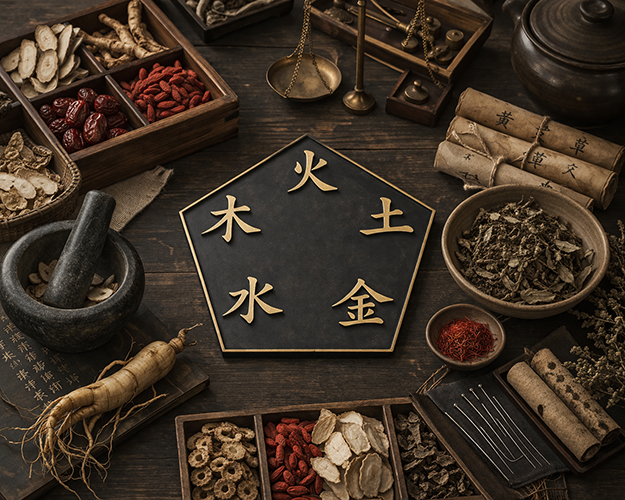
The Han dynasty is regarded as the golden age of Traditional Chinese Medicine, in which the great classical works were compiled and the theory of Qi, Yin-Yang, and the Five Elements received its definitive systematic form.
Read more
The Qin dynasty unified China for the first time under a single central authority and, through standardization, centralization, and imperial rule, created the conditions for the later development of Traditional Chinese Medicine.
Read more
The Zhou dynasty was the longest dynasty in Chinese history and formed the philosophical foundation of Traditional Chinese Medicine, with Yin-Yang, the Five Elements, and the Mandate of Heaven.
Read more
The Shang dynasty was the first historically proven Chinese dynasty and marks an early phase in the development of medicine, with the Bian stone, ritual healing, and the earliest medical instruments.
Read more
The Xia dynasty marks the transition from mythical time to dynastic order and forms an early bridge between ritual healing and the first transmission of medical knowledge.
Read more
China's mythical era forms the cultural and medical foundation of TCM, with Huang Di and the Huang Di Nei Jing as central pillars.
Read more
Chinese prehistory marks the starting point of Traditional Chinese Medicine. From early shamans to mythical culture heroes: here begins a journey of over five thousand years of medical knowledge.
Read more